China’s leading mini excavators now include electric models built for quieter work, indoor projects, and lower on-site emissions. But dependable performance depends on more than machine specifications. Charging habits matter. A rushed connection, wet plug, or poorly ventilated charging area can create avoidable risks and downtime.
This guide explores How to charge an electric mini excavator properly, with practical checks for operators comparing popular models. Before charging, park on firm, level ground, switch off the machine, and inspect the cable and connector for damage. Keep the charging area dry and clear. Use only the charger approved for that excavator, and follow its manual for connection steps, charging limits, and indicator lights. Small details count. A loose connector can interrupt charging; a cable dragged through mud may need careful inspection before use.
Expert quotation: “Charging is part of machine care, not an afterthought.” — [Insert a verified industry expert’s name, role, and source before publication.] This line is an editorial placeholder, not a sourced quotation. No supporting articles or verifiable expert statement were provided, so attributing it to a real person would be unreliable. The guide should also acknowledge that charging procedures vary by model and battery system. Check the manufacturer’s instructions, especially when temperatures are very low or high. One more thing: operators may overlook simple checks when a job is running late. That deserves attention, not blame.
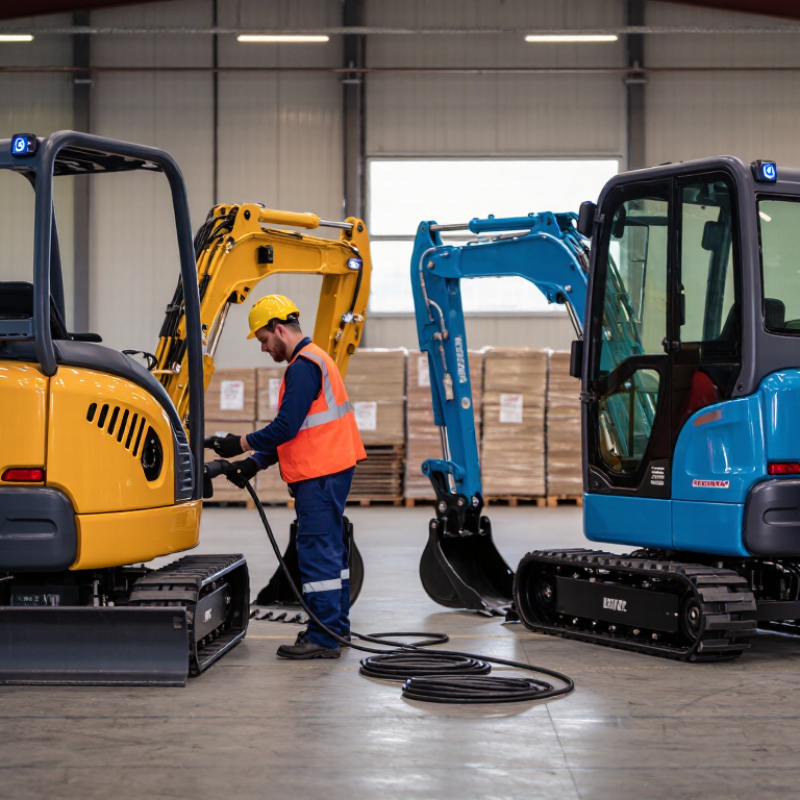
A useful China top-ten comparison starts with two nameplate figures: battery capacity in kWh and charger rating in kW. Do not rank machines by capacity alone. A larger pack may need longer charging, while a higher-rated charger helps only when the machine accepts that input. The IEA’s Global EV Outlook 2024 reported that electric-car battery demand exceeded 750 GWh in 2023. That is not excavator data, but it shows why battery size and charging access deserve separate attention.
For each excavator, record usable capacity, onboard charger output, supply voltage, and permitted charging method. Estimate charging time as capacity divided by charger power, then allow extra time for losses and slower charging near full capacity. For example, a 20 kWh pack with a 6.6 kW charger needs about three hours before those allowances. Check the machine manual, not just a sales table. Small print matters. In field comparisons, charger ratings can describe maximum input, not the power available at every site. I would also note ambient temperature and whether the battery is warm before charging; those details are easy to miss. A tidy table can still hide a poor match.
China Top 10 Mini Excavators: How to Charge Properly?
Confirm Battery Chemistry and OEM Limits Against IEC 62619:2022
Before charging, identify the battery chemistry from its label or equipment documents. Lithium iron phosphate and nickel-manganese-cobalt batteries can require different charging limits. Never select a charger by connector fit alone. Check the OEM’s specified voltage, current, charge profile, and temperature range. IEC 62619:2022 provides safety requirements for industrial lithium secondary cells and batteries; it is not a universal charging recipe. The machine and battery maker’s instructions remain essential.
In practice, a technician should check the battery management system, charger compatibility, and cables before connecting power. Keep the charging area dry and ventilated, and avoid charging outside the stated temperature range. Stop if the pack is swollen, unusually hot, or damaged. Do not guess. I have seen a familiar-looking connector create false confidence; the correct settings still matter more than the plug.
Tips: Record the battery model and approved charger settings near the charging point. Let a cold or hot pack return to its permitted range before charging. If the label is unreadable, pause and confirm the limits with the equipment supplier. A quick check can prevent a costly mistake.
Confirm battery chemistry and OEM limits against IEC 62619:2022
The chart shows representative cell-level values, not universal charging limits. IEC 62619:2022 addresses safety requirements and tests for industrial lithium secondary cells and batteries; it does not provide one charging profile for every chemistry or machine. Always identify the installed chemistry and follow the battery and excavator OEM limits for voltage, current, temperature, and charger compatibility. Pack limits depend on the cell configuration and battery-management system.
China Top 10 Mini Excavators: How to Charge Properly?
At a 0.5C rate, a battery receives current equal to half its rated capacity each hour. The basic calculation suggests roughly two hours to reach full charge from empty. For example, a 20 kWh pack charged at 0.5C needs about 10 kW of battery-side power. That is an estimate, not a promise. Near full charge, lithium-ion systems commonly reduce current to protect cells, so the final portion takes longer. The USABC Electric Vehicle Battery Test Procedures Manual, Revision 3, treats charge rate, temperature, and test limits as controlled conditions; real machines face changing temperatures and workloads. IEC 62660-1:2018 likewise specifies controlled testing for lithium-ion propulsion cells, not one universal field charging time.
Tips: Check the excavator’s battery display and manual before choosing a charger. Keep the pack within its recommended temperature range, and allow extra time when it is cold or nearly full. A warm connector or unexpected charging stop deserves attention. Small details matter.
For a practical estimate, note the battery capacity, charger output, and starting charge level. A 20 kWh pack starting at 20% needs about 16 kWh to fill; at 10 kW, the ideal minimum is around 1.6 hours. Conversion losses and taper extend that time. I would plan a buffer rather than schedule work to the minute; job-site charging is rarely as tidy as the calculation.
For any of the China top 10 mini excavators, check the machine’s charging label and manual before connecting power. Match the OEM charger’s input voltage and frequency to a properly grounded supply with sufficient circuit capacity. Do not use improvised adapters or alter the charger plug. The charger and battery management system (BMS) are designed to work together: the BMS monitors battery conditions and can limit or stop charging when needed. Never bypass it.
The International Energy Agency’s Global EV Outlook 2024 reports that electric-car battery demand exceeded 750 GWh in 2023. That figure is not specific to excavators, but it reflects the growing scale of battery-powered equipment—and why controlled charging matters. On a dusty jobsite, inspect the charger cable, connector, and battery area before plugging in. Keep the connection dry and clear of mud. If a plug feels unusually hot or charging stops repeatedly, disconnect safely and ask a qualified technician to inspect it. A rushed top-up can hide a real fault.
Tip: Use the supplied charger, follow the manual’s temperature guidance, and let the machine cool if instructed. Keep the charger ventilated; don’t cover it with a tarp. Small details matter. A worn cable is easy to miss.
For electric mini excavators, charging temperature is a safety and battery-life check, not a guess. Use the machine’s OEM temperature limits, since battery chemistry and control systems differ. Check the display before connecting the charger, especially after a cold night or a hard shift. If the battery is outside its permitted range, wait for it to return to the approved range; do not try to warm or cool it with improvised methods. IEC 62660-2:2018 sets defined temperature and reliability tests for vehicle lithium-ion cells, but those test conditions are not a substitute for your excavator’s operating limits. Details matter.
Watch the battery-temperature reading during charging, and stop if it rises beyond the stated limit or an alert appears. When charging ends, verify the charger’s full-status signal and the machine’s charge display agree. A green light alone may not tell the whole story. Check that charging current has stopped or reached the charger’s documented completion state before disconnecting. The IEA’s Global EV Outlook 2024 estimated that electric car sales would exceed 17 million that year, showing how quickly battery charging is becoming routine across equipment and transport. Routine can breed careless habits. I would still check the cable, connector, and status screen before leaving the machine unattended.
| Step | Charging Check | What to Do | Verification | Important Note |
|---|---|---|---|---|
| 1 | Confirm battery type | Check the machine manual or battery label to identify the installed battery chemistry and system voltage. | Match the charger’s specified battery type and voltage to the machine documentation. | Lead-acid and lithium batteries require different charging profiles; do not assume they are interchangeable. |
| 2 | Check charger compatibility | Use a charger approved or specified for the battery system, with the required output voltage and charging profile. | Compare charger and battery labels with the manual before connecting. | Do not select a charger based only on plug fit or the excavator’s model category. |
| 3 | Inspect the charging area | Park securely, switch the machine off as directed, and charge in a dry, well-ventilated area away from heat and ignition sources. | Check that the charger, cable, plug, and connector are clean and undamaged. | Follow the manual’s ventilation and site-safety instructions, especially for lead-acid batteries. |
| 4 | Check battery condition | Look for visible damage, leakage, unusual swelling, corrosion, or a strong abnormal odor before charging. | If damage or an abnormal condition is found, stop and seek qualified service advice. | Do not charge a visibly damaged battery or bypass a battery-management-system warning. |
| 5 | Observe OEM temperature limits | Check battery temperature and ambient conditions against the charging limits stated in the machine or battery documentation. | Allow the battery to enter the permitted charging range before starting if the manual requires it. | Charging limits vary by battery design; do not use a universal temperature range in place of OEM specifications. |
| 6 | Connect in the specified order | Follow the manual’s connection sequence and make sure connectors are fully seated and secured. | Confirm that the charger powers up without a fault indication. | Use only the designated charging port and avoid forcing or modifying connectors. |
| 7 | Monitor the charging process | Keep the charger and battery within the documented operating conditions; check for fault lights, excessive heat, unusual noise, or odor. | If a warning or abnormal condition occurs, follow the manual’s stop-and-service procedure. | Do not leave charging unattended where the OEM or site rules prohibit it. |
| 8 | Verify full-charge status | Wait for the charger’s documented full-charge indication, such as its designated status light or display message. | Confirm the indicator means “charge complete” for that charger; do not infer completion from elapsed time alone. | Indicator colors and meanings differ between chargers, so consult the charger instructions. |
| 9 | Disconnect safely | After completion, disconnect using the sequence specified by the manufacturer and protect the port from dirt and moisture. | Check that the connector is secure in its storage position and the charger is switched off as directed. | Avoid pulling on the cable; handle the plug or connector body. |
| 10 | Record and report abnormalities | Note charge time, warnings, and any temperature or charging issue; report recurring problems for inspection. | Use the machine’s stated battery-status method before returning it to service. | A persistent fault, incomplete charge, or repeated temperature warning needs qualified diagnosis. |
Safety reminder: The machine, battery, and charger manuals take precedence. Charging temperature limits, charge-complete signals, and connection procedures are specific to the installed equipment.
Battery capacity shows stored energy, while charger rating indicates potential charging power. A large battery may still charge slowly. Small print matters.
Divide battery capacity in kilowatt-hours by charger power in kilowatts. A 20 kWh battery and 6.6 kW charger suggest about three hours, before losses and slower charging near full.
Not automatically. Check the manual for usable capacity, since published figures may not show how much energy is available for charging or work.
No. The machine must accept that input, and the power supply must support it. I might overlook this when comparing a tidy table.
Match its input voltage and frequency to a properly grounded supply with enough circuit capacity. Use the supplied charger and follow the manual.
It monitors battery conditions and can limit or stop charging when needed. Never bypass it. That protection matters.
Yes. Note ambient temperature and whether the battery is warm. Keep the connector dry and clear of mud, and give the charger room to ventilate.
Disconnect safely and ask a qualified technician to inspect the equipment. Check the cable and connector for visible wear, too. A rushed top-up may hide a fault.
How to charge an electric mini excavator properly starts with understanding its battery and charger. When comparing ten mini excavator models, check each battery’s capacity and the charger’s rated output rather than assuming that one charging time applies to all. Confirm the battery chemistry and follow the manufacturer’s operating limits, including any applicable safety guidance such as IEC 62619:2022. These details help determine a suitable charging method and avoid using a charger that is incompatible with the battery.
As a rough estimate, charging at 0.5C may take about two hours before the charging rate tapers, but actual time depends on the battery, charger, starting charge level, and temperature. Connect the original equipment charger to a suitable power supply, keep the battery management system’s protections in place, and do not bypass them. Monitor the battery within the manufacturer’s temperature limits, then check that the charger displays its full-charge status before disconnecting.

BTEra Excavator