Moving two compact machines in one trip can save fuel, labor, and valuable site time. Yet the load becomes longer, heavier, and harder to inspect. This guide explains How to transport a mini skid steer and excavator together with practical planning, securement, and loading advice. The U.S. Bureau of Labor Statistics continues to identify transportation incidents as a leading category of fatal workplace injuries. That finding matters, even on short construction routes.
Know the numbers first. Check both machines’ operating weights, attachment weights, trailer capacity, axle ratings, tongue weight, and combined vehicle weight. Do not estimate by appearance. A mini excavator with a bucket can shift the center of gravity several inches. Place the heavier excavator forward, while maintaining the manufacturer’s recommended tongue weight. Keep the mini skid steer low, centered, and clear of the excavator’s swing area. Shut down engines, lower booms and buckets, lock controls, and remove loose tools before securing the load.
Small details matter. Mud on ramps can reduce traction. Wet chains can hide damage. The Federal Motor Carrier Safety Administration’s cargo-securement guidance, including 49 CFR 393.100–136, emphasizes preventing movement in all directions. Use rated chains, binders, chocks, and attachment points. Inspect them before departure and again after the first few miles. A common mistake is tightening only the visible side. That feels secure, but it may not control lateral movement. Recheck the setup honestly. If weights, dimensions, or ratings remain uncertain, stop and obtain qualified transport advice before moving.
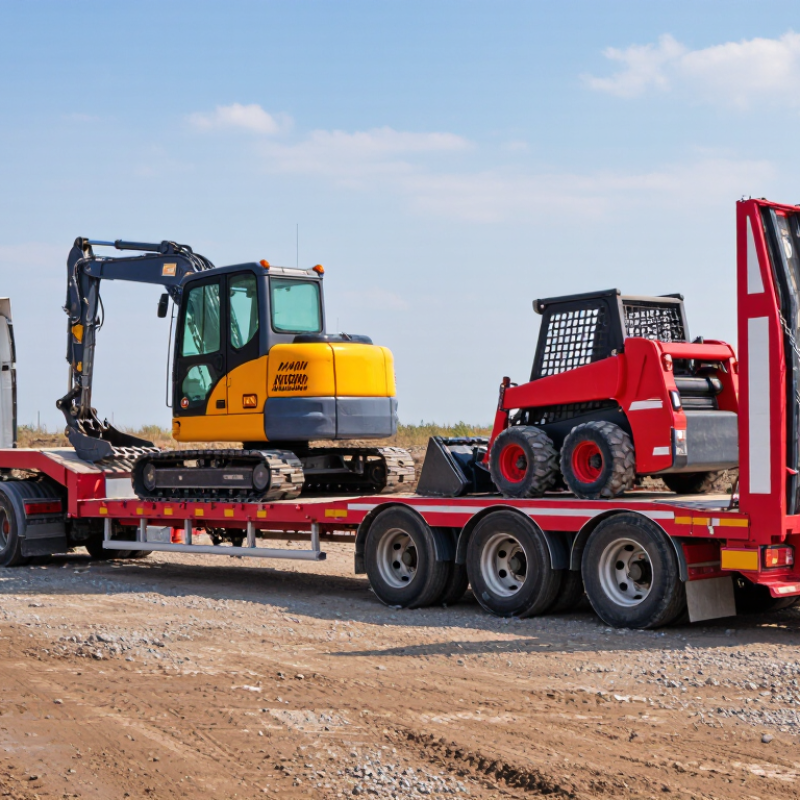
Transporting a mini skid steer and excavator together begins with honest weight calculations. Published specification data in EquipmentWatch’s 2024 market database commonly places mini skid steers near 2,500–3,500 pounds. Compact excavators often range from 5,000–7,000 pounds. Add buckets, augers, fuel, chains, and spare attachments. My first estimate is usually too low.
Consider this working example: a 2,900-pound skid steer, a 6,000-pound excavator, and 1,100 pounds of attachments create 10,000 pounds of payload. A trailer weighing 3,500 pounds brings the loaded combination to 13,500 pounds. A 14,000-pound trailer leaves almost no practical margin. A higher-rated trailer may be safer, but its empty weight must be included again. Check the trailer plate, axle ratings, tire capacity, hitch rating, and tow vehicle limits. SAE J2807 towing procedures emphasize the complete trailer load, including payload and tongue weight, rather than machine weight alone.
Securement needs equal attention. The Federal Motor Carrier Safety Administration’s Cargo Securement Handbook states that aggregate tiedown working load limit should equal at least 50 percent of the cargo weight. Use rated chains and binders at suitable frame points, not hydraulic components or handrails. Place the excavator low and centered. Keep tongue weight controlled. A public scale can expose mistakes quickly. I would recheck the numbers after adding attachments; that small oversight can change the trailer choice completely.
| Load Item | Estimated Weight (lb) | Estimated Weight (kg) | Planning Notes |
|---|---|---|---|
| Mini skid steer | 2,500–3,500 | 1,134–1,588 | Typical operating weight without unusually heavy attachments. |
| Compact excavator | 7,000–10,000 | 3,175–4,536 | Actual operating weight varies substantially by size, cab, blade, and counterweight. |
| Attachments and buckets | 500–1,000 | 227–454 | Include buckets, forks, augers, hydraulic tools, and other items loaded on the trailer. |
| Chains, binders, ramps, and accessories | 150–300 | 68–136 | Allow for tie-down equipment, spare parts, fuel containers, and loading ramps. |
| Estimated combined payload | 10,150–14,800 | 4,604–6,713 | Use the actual machine and attachment weights before selecting the trailer. |
| Recommended trailer GVWR range | 18,000–24,000 | 8,165–10,886 | A heavy-duty tandem- or triple-axle equipment trailer may be required, depending on empty trailer weight and payload. |
| Typical empty trailer weight | 4,000–6,000 | 1,814–2,722 | Confirm the trailer's empty weight on its identification plate or manufacturer specification. |
| Approximate trailer payload capacity | 12,000–18,000 | 5,443–8,165 | Payload capacity equals GVWR minus the trailer's empty weight; do not use GVWR as payload capacity. |
| Recommended payload reserve | At least 10% | At least 10% | Maintain a reserve for weight variations, additional tools, and loading-position changes. |
| Suggested tongue-weight range | 10%–15% of loaded trailer weight | 10%–15% of loaded trailer weight | Distribute the machines to maintain stable towing without exceeding the hitch or tow-vehicle limits. |
| Illustrative planning example | 12,900 payload + 5,000 trailer = 17,900 GVW | 5,851 payload + 2,268 trailer = 8,119 GVW | This example requires a trailer rated above the calculated loaded weight and a tow vehicle rated for the complete combination. |
Transporting a mini skid steer and excavator together starts before either machine reaches the trailer. Confirm the trailer’s rated capacity, deck width, ramp strength, and tie-down points. Add both operating weights, attachments, fuel, and equipment stored inside the machines. Leave a safety margin. Tight loading often causes poor weight distribution.
Clean mud from the tracks and tires before loading. Mud can reduce traction on ramps. Lower the excavator boom, crowd the bucket inward, and keep the attachment close to the machine. Place the mini skid steer where its weight balances the trailer. Shut down both engines, remove the keys, and engage parking brakes. Secure buckets, blades, booms, and hydraulic arms with rated chains or straps. Check each connection by hand. One loose binder is enough to create trouble.
Tips: Use four independent tie-down points when possible. Cross the restraints to limit side movement. Protect straps from sharp edges. Walk around the load after five minutes of travel, then inspect it again at every planned stop. A second check may feel unnecessary. It is not. I have seen operators focus on the machines and forget ramps, doors, or loose tools. Recheck the load height and width before leaving, especially after changing attachments. If the setup feels rushed, stop and correct it before moving.
The chart shows a practical preparation sequence and estimated time required before transporting a mini skid steer and excavator together. Completing these steps helps reduce movement, equipment damage, and loading risks.
Position both machines for balanced trailer weight distribution, not simply maximum deck usage. Load the excavator first, placing its heaviest components near the trailer’s axle group. Keep the mini skid steer closer to the front, but avoid excessive tongue weight. National Association of Trailer Manufacturers guidance commonly recommends tongue weight near 10–15% of the loaded trailer weight. Measure it when possible. A trailer that looks level may still handle poorly.
Lower the excavator boom and bucket completely. Keep the mini skid steer attachment low and centered. Align both machines with the trailer’s centerline. Their combined center of gravity should sit between the axles and hitch. FMCSA cargo-securement guidance requires aggregate working load limits of at least 50% of the cargo weight. Use rated chains or straps at approved tie-down points, then secure each machine independently. Check tire pressure, ramp pins, brakes, and clearance before moving.
Tips: Weigh the trailer after loading. Recheck the load after five miles. Watch for sidewall sway, loose chains, or a light steering feel. Those signs suggest poor distribution. I sometimes find the best position requires moving a machine only a few inches. Perfect balance is not always practical. Still, guessing is a weak method. Record axle weights and adjust the next load using real measurements. Always compare the final setup with local transport requirements and the trailer manufacturer’s capacity plate.
Transporting a mini skid steer and excavator together demands more than fitting both machines on a trailer. Weight distribution matters. Place the heavier excavator low and slightly forward, without exceeding axle or deck limits. Lower booms, buckets, and blades onto solid support points. Never depend on hydraulic pressure alone. It can slowly bleed off during travel. Remove loose tools and secure removable attachments separately. The load should look stable before any chain is tightened. Stable first.
Use rated chains and binders that match each machine’s working load limit. Choose tie-down points approved for transport, not handrails, cylinders, or thin panels. I prefer separate chains at each corner, with crossed restraints where the trailer layout allows. Secure the excavator through its frame and the skid steer through designated attachment points. Keep chains clear of sharp edges. Add edge protection where needed. Tighten binders evenly, then lock handles against movement. A loose handle can become a dangerous lever. Check that no chain touches hoses or wiring.
Attachments need their own restraint. A detached bucket should sit flat and be chained to the deck. A grapple or auger needs blocking against rolling. Walk around the trailer after several miles, then recheck at every planned stop. Inspect for stretched links, bent hooks, shifted tires, and settling suspension. I have occasionally tightened too quickly and missed a chain angle that reduced its holding power. That is a useful reminder: securement is a calculation, not a visual guess. Confirm the combined load, tie-down capacity, and route requirements before departure. If anything feels uncertain, stop and correct it before moving.
Transporting both machines safely starts with a careful load inspection. Confirm the trailer’s GVWR, axle ratings, deck length, and available payload. Add the machines, attachments, fuel, chains, and ramps. The combined weight must stay below the trailer’s rated capacity. Position the excavator’s heaviest section near the axle group. Keep the mini skid steer centered and avoid excessive tongue weight. Lower both attachments fully. Remove loose buckets, tools, and debris.
The Federal Motor Carrier Safety Administration’s cargo securement guidance requires tiedowns to provide an aggregate working load limit equal to at least 50% of the cargo weight. Use rated chains and binders at approved tie points. Secure each machine separately. Check track contact, parking brakes, hydraulic locks, and ramp pins. Walk around the load before departure. Something can look tight and still move. After the first few miles, stop on level ground and inspect every binder, chain, and strap. Road vibration changes tension.
Tips: Keep the deck dry and clear. Place wood blocks behind tracks when needed. Cover exposed hydraulic controls. Drive smoothly, especially during turns and braking. Recheck the load after steep grades or rough pavement. FMCSA inspection guidance emphasizes correcting shifting cargo before continuing. I still allow extra inspection time because a rushed final check is where small mistakes survive. Never exceed posted speed limits or the trailer’s tire and axle ratings.
Add the mini skid steer, excavator, attachments, fuel, chains, and stored tools. A 2,900-pound skid steer and 6,000-pound excavator need 1,100 pounds for attachments. That creates 10,000 pounds of payload. My first estimate is often wrong.
Add the empty trailer weight to the payload. A 3,500-pound trailer creates a 13,500-pound loaded combination. A 14,000-pound rating leaves very little practical margin. That margin disappears fast.
Check the trailer plate, axles, tires, hitch, and tow vehicle limits. The lowest rating controls the safe combination. Include tongue weight in the calculation. A heavier trailer may help, but its own weight reduces capacity.
Keep the excavator low and centered. Position the mini skid steer to balance the trailer. Control tongue weight without shifting excessive weight behind the axles. Tight loading can still create poor balance.
Remove mud from tracks and tires. Mud can reduce grip on ramps. Lower the excavator boom and pull the bucket inward. Keep attachments close to each machine.
Use rated chains or straps at strong frame points. Avoid hydraulic parts, handrails, and fragile attachments. Use four independent tie-down points when possible. Cross the restraints to limit side movement.
Shut down both engines and remove the keys. Engage the parking brakes. Secure buckets, blades, booms, and hydraulic arms. Check every connection by hand. One loose binder is enough.
Walk around the load after the first few minutes. Inspect it again at every planned stop. Look for loose binders, shifting equipment, damaged straps, and unsecured tools. A second check feels unnecessary sometimes. It is not.
How to transport a mini skid steer and excavator together requires careful planning, accurate weight calculations, and a trailer rated for the combined load. Begin by confirming the operating weights of both machines, along with the trailer, fuel, attachments, and tie-down equipment. The trailer should have sufficient capacity, suitable dimensions, reliable brakes, and properly rated ramps. Before loading, clean the equipment, lower or remove attachments when practical, secure movable parts, check fluid leaks, and ensure both machines are ready for transport.
For balanced weight distribution, position the heavier excavator near the appropriate axle area and place the mini skid steer so the trailer tongue has safe downward weight without becoming overloaded. Keep both machines centered and maintain adequate clearance. Secure each machine independently with rated chains, binders, and approved attachment points, while engaging parking brakes and lowering implements. Inspect every connection, ramp, tire, light, and hitch before departure. During towing, drive at a controlled speed, allow extra stopping distance, take turns carefully, and stop periodically to recheck the load.

BTEra Excavator